


Table Of Content
Sora is gone. OpenAI closed the Sora app and sora.com on 26 April 2026, and on 24 September 2026 the Sora 2 API and every Sora 2 model go with it. If a tool you pay for still shows a "Sora 2" button, that button stops working on that date, whether or not the vendor has told you.
We used Sora 2 in OpenAI's app and inside Zebracat, where our routing could pick it until OpenAI retired it. Here is what replaced it, priced per finished video rather than per clip, and what nobody can give you back.
The Short Answer
Four picks, by the job you were actually doing with Sora.
- Finished, post-ready social video from a script or an idea: Zebracat. Text in, a whole video out: script, scenes, voiceover, music and captions, then scheduled and posted to TikTok, Instagram and YouTube. It routes every scene across the leading video models, so no single shutdown breaks your pipeline. Cat Mode is $39 a month, or $23 billed yearly.
- Raw clips, where the shot is the deliverable: Google Veo 3.1, or Kling 3.0. The two destinations commentary converges on. Veo 3.1 is the closest like-for-like on one-pass video with synchronized audio, Kling 3.0 the pick for dialogue. Neither writes a script, voices it, captions it or publishes it.
- Cheapest per generated second: Seedance via Dreamina, or Wan hosted on Alibaba Cloud at $0.10 a second for 720p. Dreamina publishes promotional rates only.
- Open source and self-hosted: Wan 2.2, Apache 2.0. Free software, real hardware. Wan 2.5 and above are API only.
Nothing here replaces cameos, the record-yourself-once-then-appear-anywhere workflow, which lived in the app, not the API.
Looking For Sora Login, Download Or Pricing?
Logging in or downloading: nothing to log into. The app and sora.com closed on 26 April 2026, and the iOS listing is gone.
Pricing: there was never a standalone Sora plan. It came bundled with ChatGPT Plus at $20 a month and ChatGPT Pro at $200. Both plans are still sold; the Sora access inside them ended.
Your files: the export page was sora.chatgpt.com/sunset. See below.
How We Tested, And Who We Are
We make Zebracat. We used Sora 2 in OpenAI's app, and inside Zebracat, where Sora 2 was one of the models our routing could pick until OpenAI retired it. For this page we tested the replacements the way we run production work: Veo 3.1, Kling 3.0 and Seedance 2.5 inside Zebracat, and the raw-clip tools on paid plans where a paid plan exists, with Kling Basic and self-hosted Wan on their free tiers. No vendor paid for a placement or saw a draft.
Many of the Sora alternative lists you will find are affiliate lists: they earn a commission when you sign up through their link, so their order follows the payout. This page has no affiliate links. It sits on zebracat.ai, so read the Zebracat entry with that in mind and check every number yourself.
Every price on this page was read on the vendor's own pricing page in September 2026, and where a vendor publishes nothing we say so. The number we care most about is not the plan price. It is credits per clip, times clips per video, times retries: what one finished video costs.
What Happened To Sora
Three dates, all on OpenAI's own pages. Announced 24 March 2026 on the API deprecations page. App and web went off on 26 April 2026, per OpenAI's help center article on the Sora discontinuation. The Videos API and every Sora 2 model go off on 24 September 2026, recommended-replacement column empty: OpenAI is retiring a video API and naming no successor.
The entire public statement, posted from the Sora account on X and reported by TechCrunch in March 2026: "We're saying goodbye to the Sora app. To everyone who created with Sora, shared it, and built community around it: thank you." No reason was given.
What it was genuinely good at. Sora 2 modelled failure, not just success: OpenAI's launch post used a missed basketball shot rebounding off the backboard instead of teleporting into the hoop. It generated synchronized audio natively, "sophisticated background soundscapes, speech, and sound effects with a high degree of realism", and followed "intricate instructions spanning multiple shots while accurately persisting world state". Cameos let you record one consented clip and then appear, with your voice, in anything you generated. That is what made it spread.
In my own use, the wow factor was realism and physics. Motion, animals, water drops, the small things earlier models got wrong, felt believable for the first time, and dialogue in street-interview style clips finally sounded natural. Three things wore that down in daily use. Content moderation was aggressive and unpredictable: prompts with nothing objectionable in them triggered violations at random. That made Sora 2 hard to put into a predictable workflow for growing a social channel. And character consistency was still a problem.
Why it went. TechCrunch, reporting a Wall Street Journal investigation in March 2026, put it at roughly $1 million a day in running cost, users peaking near 1 million then falling below 500,000, and compute redirected to coding tools. That is journalism, not a statement. The app lasted under seven months, and Disney announced a $1 billion licensing investment tied to Sora on 11 December 2025, three months before the shutdown.
What it cost. Bundled into ChatGPT Plus at $20 a month and ChatGPT Pro at $200, with extra generations at $4 for 10 from 30 October 2025. Sora head Bill Peebles said "the economics are currently completely unsustainable". On the API it runs $0.10 to $0.70 a second: a 20-second 1080p clip costs $14.00.
Verified September 2026
- Announced 24 March 2026. App and web went off on 26 April 2026. The Videos API and all Sora 2 models go off on 24 September 2026.
- OpenAI's deprecations table lists no recommended replacement for any Sora model or for the Videos API.
- OpenAI never published a reason. The help center article has dates, export steps and a refund pointer, nothing else.
- API list price ran from $0.10 per second for sora-2 at 720p to $0.70 for sora-2-pro at 1080p.
- There was never a standalone Sora plan: ChatGPT Plus at $20 a month, ChatGPT Pro at $200, top-ups at $4 for 10 generations.
- On 8 September 2026 OpenAI told developers asking for open weights it had no release plan or timeline. There is no self-hosted Sora.
Read on OpenAI's help center, API deprecations page and model documentation in September 2026. The operating-cost and user-decline figures reported by TechCrunch are journalism, not OpenAI statements, and are labelled as such throughout.
If Your Tool Runs On The Sora API, Read This
This hits people who never opened the Sora app. Any "Sora 2" feature inside a third-party product is OpenAI's API behind someone else's button, so when the API shuts down on 24 September 2026 it stops everywhere at once. InVideo says so on its own Sora page: access ends when OpenAI's does, and no platform can offer Sora generations after that date. Replicate posted the same notice. Several multi-model platforms were still selling Sora 2 with no notice when we checked in September 2026.
How to check whether your tool depends on the Sora API:
- Read the model picker, not the marketing page. If "Sora 2" is selectable, that tool calls OpenAI's Videos API, and that path closes on 24 September.
- Open your saved presets and workflows. Anything built before April 2026 can have a model pinned inside. Read the model field, not the default.
- Ask support one question in writing: which model generates my videos today, and which one will after 24 September 2026. A vendor who cannot answer that in one sentence is not one to plan around.
The lesson is bigger than Sora. A pipeline standing on one vendor's model is one product decision away from stopping, with no notice and no replacement column. Zebracat routes every scene across several leading models instead, and our model hub carries the dated line: "Sora 2 (OpenAI): Retired. OpenAI closed the Sora app on April 26, 2026 and shuts the API on September 24, 2026. Use Veo 3 instead." When Sora 2 was retired, routing moved those scenes to Veo 3.1 and Kling 3.0 and users changed nothing. The list is on the AI video models page.

Get Your Sora Videos Out
OpenAI's export page was sora.chatgpt.com/sunset, plain text here because there is nothing left to send you to. The help center article told users to click Export "as soon as possible", said OpenAI had not decided whether a final export window would open, and said it would afterwards permanently delete any Sora data. We could not verify whether that window opened. Two details are easy to miss: purchased credits stayed usable for Codex rather than being refunded, and refunds ran through the standard ChatGPT subscription policy.
On cameos, the honest answer. OpenAI has published nothing about cameo models or likeness data beyond the blanket deletion statement. If you uploaded your face, no authoritative document says what became of it. We could not verify it, so we will not guess.
What A Finished 60-Second Video Costs
Every other Sora alternatives list we read in September 2026 prices subscriptions, and none of them priced a finished video. Here is that arithmetic, with Sora at its list price as the baseline. A 60-second video cut from 8-second clips needs 8 clips; one retry per scene makes 16 generations and 128 generated seconds, on each tool's mid plan at 720p.
| Setup | Clips needed | Credits, clean pass | Credits, one retry per scene | Cost at monthly rate | Still to do afterwards |
|---|---|---|---|---|---|
| Zebracat, Cat Mode | Handled for you | 1 of 15 monthly videos, script, images, voices and captions included | Regenerate scenes inside the same video | About $2.60 per video at $39 a month. | Review and publish. Script, scenes, voiceover, music and captions are already in it. |
| Sora 2 API at 720p, for reference | 8 at 8s | Per second: 64s | 128s | $6.40 clean, $12.80 with retries, at $0.10 a second | Script, voiceover, music, captions, resize, assemble, schedule |
| Sora 2 Pro API at 1792x1024 | 8 at 8s | 64s | 128s | $32.00 clean, $64.00 with retries, at $0.50 a second | Same as above |
| Veo 3.1 Quality, AI Pro at $19.99 | 8 at 8s | 800 credits | 1,600 credits | $12.79 with the 50 free daily credits, $31.98 on plan credits alone | Same as above |
| Kling 3.0, Pro at $32.56 | 8 at 8s | ~256 credits | ~512 credits | About $5.56 | Same as above |
| Runway Gen-4.5, Pro at $35 | 8 at 8s | 768 credits | 1,536 credits | $23.89 monthly, $19.11 annual | Same as above |
| Seedance 2.0, Dreamina Pro at $11 | 8 at 8s | ~1,024 credits | ~2,048 credits | About $5.89, promotional pricing | Same as above |
| Luma Ray3.14 at 720p, Pro at $90 | 8 at 8s | 1,280 credits | 2,560 credits | About $5.76 | Same as above |
| Pika 2.5 at 720p, Pro at $35 | 8, billed as 10s units | 320 credits | 640 credits | About $9.74 | Same as above |
| Wan 2.7 hosted, or Wan 2.2 self-hosted | 8 at 8s | Per second: 64s | 128s | $6.40 clean and $12.80 with retries hosted, or $0 in licence fees self-hosted | Same as above |
Method: 8 clips of about 8 seconds, two generations each, mid plan, 720p, with one exception: the sora-2-pro row is priced at OpenAI's $0.50 a second tier, which is 1792x1024, not 720p. Kling's credits per second are derived on an assumed 5-second unit, since Kling does not publish the clip length behind its 20-credits-per-720p-video figure. Dreamina publishes promotional charges only. Zebracat does not publish a per-video credit figure on its pricing page, so the Cat Mode line is the plan's allowance of 15 videos a month divided into the monthly price.
Nine of the ten setups end with a folder of clips and an afternoon of work: your time, or more subscriptions.
The 8 Best Sora Alternatives in 2026
One list, grouped by the job. Pick your group, read two entries, stop.
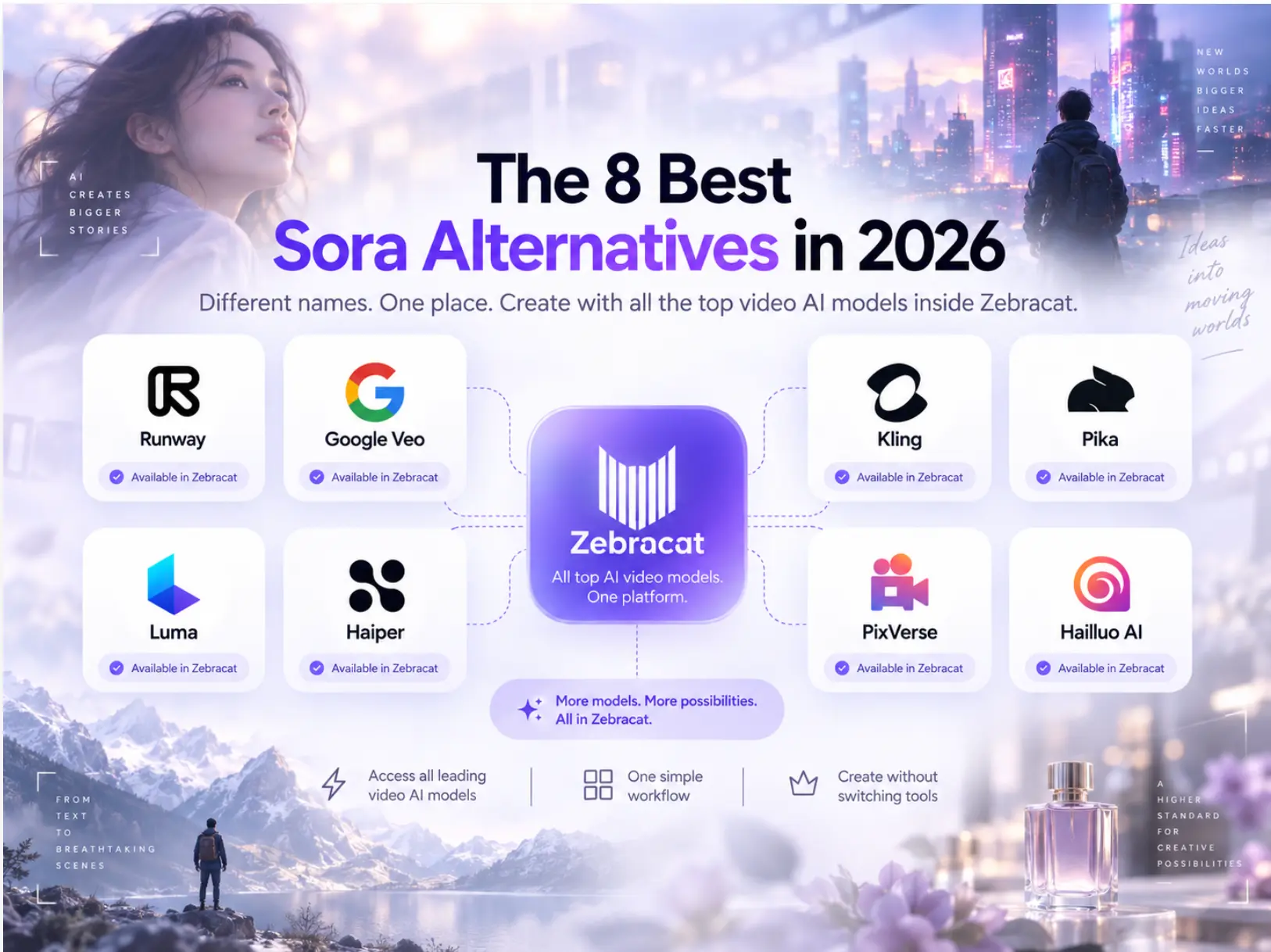
For finished, post-ready videos
1. Zebracat - Best for finished, published videos
Zebracat takes a script, a blog post, a URL, an audio file or an idea and returns a finished video: scenes, voiceover, music and captions, then schedules and posts it to TikTok, Instagram and YouTube. Built for people whose deliverable is a post, not a shot.
Why choose Zebracat over Sora
Two reasons, and the first is why this page exists. Zebracat does not stand on one model. It reads your script and routes each scene: dialogue to Veo 3.1, a chase to Kling 3.0, a long take to Seedance 2.5, a still to Nano Banana, with new models running inside it within days of release. Prompts are tuned per model, and you can override the pick per scene. When OpenAI retired Sora 2, those scenes moved to Veo 3.1 and Kling 3.0 and nothing changed for users.
The second reason is scope. Sora gave you a clip, a very good one, with sound in it. It did not write your script, voice it, caption it or post it. Zebracat is built for the whole job: it proposes what to make from your site and niche, produces it, posts it, then learns.
In our own production, Sora 2 earned its scenes on physics and natural dialogue, and by mid 2026 models such as Seedance 2.5 competed with it on both. Those run inside Zebracat, so when OpenAI retired Sora 2 the routing picked them for the same scenes.
Zebracat Best Features
- Text to finished video: script, scenes, voiceover, music and captions in one pass, no timeline
- Automatic model routing: the right model per scene across Veo 3.1, Kling 3.0, Seedance 2.5 and Nano Banana, tuned for cost and quality
- Shutdown-proof by design: when a model is retired, routing moves those scenes and nothing in your workflow changes
- Manual model override: every scene shows its model, and you can regenerate it alone
- Publishing and growth loop: schedules and posts to TikTok, Instagram and YouTube, then learns from results
- AI avatars and voice cloning: a presenter without a camera, in your voice cloned from a 30-second sample, the nearest thing to a cameo
- Everything is included in the video allowance: script generation, image generation, top-tier AI voices and cloned voices do not eat into your credits. Only high-end extras such as AI animation models draw on the separate AI credit pool. Pricing is built for testing video formats and scaling social content, not for metering every step
Zebracat Limitations
- No cameo equivalent: avatars and voice clones give a consistent presenter, but nothing reproduces Sora's record-once-then-appear-anywhere workflow, and our assessment is that nobody does
- Length ceiling: 2 minutes on Cat Mode, 5 on higher plans
- Limited free plan: 5 videos total, 720p, 30 seconds each
- Export tops out at 1080p: Veo renders 4K at the clip level, but the export is 1080p on every plan
- Per-video credit cost is not published: the pricing page lists videos and a credit pool, not per-video use
Zebracat Pricing
- Free: 5 videos in total, 720p, up to 30 seconds each, no credit card
- Cat Mode: $23 a month billed yearly, or $39 month to month. 15 videos a month, 2 minute maximum, 350 generative credits, 1080p, no watermark
- Super Cat: $59 a month billed yearly, or $99 month to month. 40 videos, 5 minute maximum, 1,400 credits, 5 custom avatars, 5 voice clones, 5 brand kits
- Unlimited Cat: $119 a month billed yearly, or $199 month to month. Unlimited videos, 3,600 credits, 10 avatars, 10 voice clones
- Enterprise: from $599 a month, with a dedicated success manager, private infrastructure and volume rates
- API: pay as you go from $10, usage based, no commitment
Which Zebracat Plan Is Best For You?
- Cat Mode if you publish a few videos a week, watermark-free at 1080p.
- Super Cat for brand or client accounts needing avatars, voice clones and translation, where the nearest-to-cameo features live.
- Unlimited Cat if video count is the constraint. Detail on the pricing page.
For raw video clips
Read this before the next six. These tools sell raw clips: the shot, and nothing around it. To make something postable you need editing skills and usually additional subscriptions for the editor, the voiceover, the captions and the music. If that is your workflow they are the right pick, and Sora was one of them. Otherwise the price per clip is not what you pay.
2. Google Veo 3.1 - Closest to what Sora 2 did
Google's flagship model, used through Flow or Gemini, and the closest thing to what Sora 2 did in one pass: speech, effects and ambience generated with the picture, up to 4K. You get back the native audio Sora users missed most, at higher resolution. You do not get cameos, the feed, or Sora's clip length: Flow caps Veo 3.1 at 8 seconds.
Veo 3.1 Pricing
- Free: 50 Flow credits a day, about five Lite generations. Watermark and commercial-use terms not published by the vendor
- Google AI Pro: $19.99 a month, 1,000 Flow credits
- Google AI Ultra: $99.99 for 10,000 credits, or $199.99 for 25,000
- Per generation: Lite 10 credits, Fast 20, Quality 100, Ultra included
- API: $0.40 a second with audio, $0.60 at 4K
Who should skip it
Anyone whose problem was never the shot: Veo hands back the same unfinished object. Veo 3.1 also runs inside Zebracat, with the specs on our Veo 3 page.
3. Kling 3.0 - Best for dialogue and long clips
Kuaishou's model, the other consensus destination and the default in most migration threads: native audio in five languages, 15-second clips, native 4K. You get back synchronized audio and the longest clip here, plus references that hold a character across shots. You do not get cameos, or Sora's physics, which nobody has benchmarked against Kling.
Kling 3.0 Pricing
- Basic: $0, no monthly credits, no commercial use, watermark removal paid only: a demo, not a free tier
- Standard: then $8.80 a month, 660 credits
- Pro: then $32.56 a month, 3,000 credits
- Premier and Ultra: then $80.96 for 8,000 credits, or $159.99 for 26,000. Headline prices are one-time offers, so budget the "then" rate
Who should skip it
Anyone who needs commercial rights without paying. Finishing the video is still your problem. Kling 3.0 also runs inside Zebracat, with the specs on our Kling 3 page.
4. Runway Gen-4.5 - Best for shot-level control
The film-and-agency end of this list: a generator in a production workspace, with the most transparent pricing page here. You get back predictability, since Gen-4.5 costs a vendor-stated 12 credits per generated second. You do not get audio: Runway bills that separately, and whether Gen-4.5 produces synchronized audio is not stated anywhere we could reach.
Runway Pricing
- Free: 125 one-time credits, watermarked
- Standard: $12 a month annually, $15 monthly, 625 credits, no watermarks
- Pro and Max: $28 and $76 a month billed annually, $35 and $95 monthly, 2,250 and 9,500 credits
- Commercial use: permitted on every tier, stated in the terms, which is rare
Who should skip it
Anyone at volume: one 60-second video with retries burns 68% of a Pro month. At that rate the number that matters is cost per finished video, not cost per shot, which is the case for a routed tool such as Zebracat.
5. Seedance 2.5 - Best for long, cheap takes
ByteDance's model, used through Dreamina or CapCut, and the third name in most migration commentary: 4 to 30 seconds a clip, extendable twice, native audio, up to 4K. You get back far more length per generation than Sora offered, which matters if you liked world state holding across a sequence. You do not get cameos, or prices you can plan on.
Seedance Pricing
- Dreamina, promotional monthly: Standard $5 for 1,575 credits, Pro $11 for 3,885, Max $42 for 8,645
- Per generated second: $0.046 for Seedance 2.0 on Pro, $0.097 for Seedance 2.5 at 720p annually
- Not published by the vendor: renewal rates, free credit amounts, free-tier watermark and commercial terms
Who should skip it
Anyone who needs a price for a budget, or terms before generating. Seedance 2.5 also runs inside Zebracat, with the specs on our Seedance 2.5 page.
6. Luma Dream Machine - Best for fast iteration
Luma runs its own Ray3.2 and Ray3.14 models alongside third-party ones, including Veo 3.1 and Kling 3.0, on a single credit balance. You get back a large allowance: 10,000 credits on Plus, 150,000 on Ultra. You do not get audio: the audio column is empty for every Ray row on Luma's own table.
Luma Pricing
- Plus: $30 a month, $300 a year, 10,000 credits, commercial use listed
- Pro and Ultra: $90 a month for 40,000 credits, $300 for 150,000
- Credit cost: Ray3.14 is 20 credits a second at 720p
- Free tier: off the pricing page, personal projects only, and the vendor states its watermark survives an upgrade
Who should skip it
Anyone who needs sound, or who plans to use free-tier output.
7. Pika - Best free tier, cheap effect clips
The cheapest option here: 5 and 10 second clips up to 1080p, 25 seconds through Pikaframes. If what you enjoyed about Sora was making a short strange funny thing quickly, Pika is closest in spirit. You do not get audio, only Pikaformance lip-syncing to audio you supply, and no cameos.
Pika Pricing
- Basic: $0, 80 credits a month, 480p, no watermark and commercial use both stated
- Standard: $8 a month yearly, $10 monthly, 700 credits, all resolutions
- Pro and Fancy: $28 and $76 a month billed yearly, 2,300 and 6,000 credits
- Credit cost: 20 credits for a 5-second 720p clip
Who should skip it
Anyone who needs dialogue or sound, or anything longer than a moment.
Open source and self-hosted
One caveat: cheap per generation and cheap per finished video are different numbers. Free software on your GPU beats a subscription only if hardware and hours cost nothing.
8. Wan 2.2 - Best open-source option
The honest answer to the open-source question, with a correction most pages get wrong: Alibaba's newest open-weights release is Wan 2.2, Apache 2.0, while Wan 2.5 and above are API only with no public repositories. You get back what OpenAI refused everyone: weights you own, which cannot be deprecated out from under you. You do not get quality parity, a hosted queue, a support desk, or Sora's audio and cameo features.
Wan Pricing
- Wan 2.2 self-hosted: $0 in licence fees, Apache 2.0, commercial use included
- Hardware: 24 GB VRAM for TI2V-5B, 80 GB for the 14B models, per the vendor's README
- Hosted on Alibaba Cloud: wan2.2-t2v-plus $0.02 a second at 480p, $0.10 at 1080p; wan2.7-t2v $0.10 at 720p, $0.15 at 1080p
- Hosted free quota: 50 seconds, Singapore, 90 days, watermark policy not published
Who should skip it
Anyone who wants a video this afternoon. Self-hosting is a skill, not a signup, and solves vendor risk alone.
If You Used Sora For This, Use This Now
Sora was not one product to its users. It was five, and only some have successors.
| What you used Sora for | Use this now | What you gain, and what you lose |
|---|---|---|
| Cameos and likeness | Zebracat avatars and voice clones, Super Cat and above | A consistent presenter with your cloned voice from a 30-second sample. Our assessment: nothing reproduces the cameo workflow, which lived in the app |
| Native synchronized audio | Veo 3.1, Kling 3.0 or Seedance 2.5 | All three generate speech, effects and ambience inside the clip. Runway, Luma's Ray models and Pika generate none |
| Physics and prompt adherence | Veo 3.1, then Kling 3.0 | The two the commentary converges on. No published benchmark compares either to Sora 2: consensus, not measurement |
| The remix feed and the social loop | Nothing | No replacement exists. The feed, the drafts and the cameo tagging were the app |
| Type something, post it the same hour | Zebracat | Script, scenes, voiceover, captions and scheduling in one pass |
| A Sora-style API in your own product | Zebracat API, or Veo 3.1 on Vertex, or Wan on Alibaba Cloud | Zebracat returns a finished video from one request, pay as you go from $10. The other two return clips at published per-second prices. None is a drop-in port |
Sora Alternatives Compared
| Tool | Best for | Where the visuals come from | What happens after the video is made | Starts at |
|---|---|---|---|---|
| Zebracat | Text into finished, published video | Generated, with the best model picked per scene across Kling, Veo, Seedance and others | Schedules and posts across platforms including YouTube, then learns from results | $23/mo |
| Google Veo 3.1 | Closest like-for-like on one-pass video with audio | Veo 3.1 in Flow or Gemini, up to 4K | You export, or assemble shots in Flow | $19.99/mo |
| Kling 3.0 | Dialogue, performance, 15-second clips | Kling 3.0 and 3.0 Omni, native 4K | You export the clip | $8.80/mo |
| Runway | Shot-level control and studio export | Gen-4.5, 12 credits per generated second | You export to your editor | $12/mo |
| Seedance 2.5 | Long takes and continuity | Seedance via Dreamina or CapCut, 4 to 30s | You export the clip | $5/mo promotional |
| Luma Dream Machine | Fast iteration on a large credit balance | Ray3 models, plus Veo 3.1 and Kling 3.0 | You export the clip | $30/mo |
| Pika | Cheap effect clips for social | Generated by Pika 2.5 | You export the clip | $8/mo |
| Wan 2.2, self-hosted | Zero licence cost, no vendor risk | Apache 2.0 open weights, your own GPU | You build the rest yourself | $0 plus hardware |
| Sora 2 (for reference) | Retiring: app closed 26 April 2026, API shuts down 24 September 2026 | sora-2 and sora-2-pro, up to 1080p, native audio, cameos | You exported the clip, or posted to the Sora feed | Was $20/mo inside ChatGPT Plus |
Starting prices are the cheapest paid plan, annual billing where published, read on each vendor's own pricing page in September 2026. Kling's is the rate after its first-month offer.
Seven of the eight live tools end at "you export the clip", which is where Sora ended. Most people replaced one clip generator with another.
Where The Market Moved Since Sora Died
Nobody publishes migration data for where Sora users went, and most "where everyone went" articles are written by tools recommending themselves.
Search interest can be measured. Per SE Ranking data read in September 2026, US searches for "veo 3" went from 9,900 to 60,500 a month over twelve months, about +511%, and "seedance" from 540 to 12,100, about +2,140%. The other way, "hailuo ai" fell from a February 2026 peak near 110,000 to 40,500, and "kling ai" is off its peak of 135,000 at 96,200. Sora's brand demand outlived the product: "sora ai" is at an all-time high of 60,500 a month, and so is "sora app", for an app that closed in April.
Read that as attention, not quality. If a tool is in visible decline and you cannot self-host it, you are taking the bet Sora users took.
Free Sora Alternatives, Watermarks Included
"Free" is the first word most people add to the search, and most lists answer yes or no. The useful questions: is the output watermarked, may you use it commercially, is it postable.
| Tool | Free cap | Watermark | Commercial use | Resolution | Verdict |
|---|---|---|---|---|---|
| Pika | 80 credits a month, about six 5s clips | No, stated on the plan | Yes, stated on the plan | 480p | The only one answering both questions in your favour |
| Zebracat | 5 videos total, not per month | Not stated on /pricing, which lists watermark removal as paid | Commercial rights stated for paid plans | 720p, 30 seconds | Enough to see whether a finished video is what you wanted |
| Google Veo 3.1 | 50 a day: five Lite generations, zero Quality | Not published by the vendor | Not published by the vendor | Lite tier only in practice | Generous on paper, thin in practice |
| Runway | 125 credits once, about ten seconds of Gen-4.5 | Yes, watermark-free from Standard | Yes, stated in the terms, all plans | Not published | A trial, not a tier: it does not renew |
| Kling 3.0 | No monthly credits on Basic | Yes, removal is paid only | No, the vendor states Basic output is not for commercial use | 1080p is paid only | A demo account, not a free tier |
| Seedance via Dreamina | Free daily credits, amount not published | Not published, vendor says it may vary | Not published by the vendor | 720p on free promo generations | Unknowable before you sign up |
| Luma Dream Machine | Off the pricing page, amount unpublished | Yes, and the vendor says it survives an upgrade | No, personal projects only | 720p, draft quality | The harshest terms here |
| Wan | 50 free seconds hosted. Unlimited self-hosted | Not published for the hosted quota | Yes for the open weights, Apache 2.0 | 720p and 1080p hosted | Genuinely unlimited, if you own the GPU |
Read on each vendor's own pricing, terms or documentation pages in September 2026. Where a vendor publishes no free-tier watermark or commercial terms, we say so.
Pika for free output you may legally post, Wan self-hosted for volume. Nothing else here is a free tier in any useful sense.
For Developers: Replacing The Sora API
The Videos API and every Sora 2 model go off on 24 September 2026 with no recommended replacement, so this is a port, not a migration, and the window is short. For calibration, sora-2 is $0.10 a second at 720p, sora-2-pro $0.70 at 1080p.
- Veo 3.1 on Vertex AI: $0.40 a second with audio, $0.60 at 4K. Fast $0.10 to $0.30, Lite $0.05
- Wan on Alibaba Cloud: wan2.2-t2v-plus $0.02 a second at 480p and $0.10 at 1080p; wan2.7-t2v $0.10 at 720p
- Runway Gen-4.5: 12 credits a generated second, about $0.19 on Pro, our arithmetic not a published rate
- Kling, Luma, Pika and Seedance: no per-second API list price on any vendor page
- Self-hosting: Wan 2.2, Apache 2.0, 24 GB VRAM for TI2V-5B and 80 GB for the 14B checkpoints. No open-weights Sora exists
If the single point of failure matters more than the price, the fix is an abstraction that swaps models without your code changing. Zebracat's API does that: one request returns a finished video, with the model routing handled for you, plus agentic video, translation, voice cloning, characters, scheduling and webhooks. Pay as you go from $10, usage based, no commitment; Enterprise adds volume rates, private infrastructure and white-label generation. Details on the API page.
How To Switch, And Where To Go
Pick by the problem, not the model leaderboard, which changes monthly.
| Your problem now that Sora is gone | Go to | Why |
|---|---|---|
| Credits vanish and I still have to assemble the video | Zebracat | The plan buys finished videos, and publishing is included |
| A tool I pay for had a Sora 2 button and now it does not | Zebracat, or any platform that states its routing | The fix is not a new single model, it is not depending on one |
| I want the closest thing to what Sora 2 generated | Google Veo 3.1 | One-pass video with synchronized speech, effects and ambience, up to 4K |
| I need dialogue and clips longer than 10 seconds | Kling 3.0 | 15-second clips, native audio in five languages |
| I need the cheapest generated second | Seedance via Dreamina | $0.046 a generated second for Seedance 2.0 on Pro |
| I want free output I am actually allowed to publish | Pika | The free plan states no watermark and commercial use, alone here |
| I refuse to depend on any vendor again | Wan 2.2 self-hosted | Apache 2.0 weights on your own GPU. Nothing to deprecate |
| Raw clips were always my deliverable and my stack is built | Stay with a raw-clip tool: Veo 3.1, Kling 3.0 or Runway | A real answer, not a consolation. With an editor, a voiceover workflow and captions already running, a finished-video tool takes control away |
To test the difference, run one script through both, starting on the text to video flow and compare what comes back with the last clip you generated anywhere else.
Sora Alternatives: FAQ
Are there any free alternatives to Sora?
Yes. Pika's free plan is the most usable: 80 credits a month at 480p, with no watermark and commercial use both stated on the plan. Wan 2.2 is free to self-host under Apache 2.0 if you own a 24 GB GPU. If you want a finished video rather than a clip, Zebracat's free plan gives you 5 to test with.
What to use now that Sora is gone?
For finished, post-ready social video from a script or an idea, Zebracat, which routes each scene across several leading models so no single shutdown breaks it. For raw clips, Veo 3.1 for one-pass video with audio, Kling 3.0 for dialogue.
What can I replace Sora with?
Depends what you used it for. Native audio: Veo 3.1, Kling 3.0 or Seedance 2.5. Cameos: the nearest is a custom avatar with a cloned voice, in Zebracat. The type-and-post loop: Zebracat. The remix feed: nothing.
Is there any AI better than Sora?
On specific axes, yes. Veo 3.1 renders up to 4K where Sora 2 topped out at 1080p. Kling 3.0 runs to 15 seconds a clip, Seedance 2.5 to 30. On cameos nothing is better, because nothing else does it.
Does Sora have a competitor?
It had several, and they outlived it. Veo 3.1 and Kling 3.0 are the most-cited replacements, both with native synchronized audio. Seedance 2.5 is third, with 30-second takes. Runway, Luma and Pika cover shot control and effects.
Why did Sora shut down?
OpenAI never published a reason: its help center article gives dates, export steps and a refund pointer, nothing more. TechCrunch, reporting a Wall Street Journal investigation in March 2026, cited roughly $1 million a day in running costs and falling usage.
Is Sora officially gone?
The consumer product is, and the developer side goes next. The app and sora.com shut down on 26 April 2026, and the Sora 2 API shuts down on 24 September 2026, after which OpenAI says it will permanently delete any Sora data.
When does the Sora API shut down?
24 September 2026, announced on 24 March 2026 on OpenAI's API deprecations page. Going with it: sora-2, sora-2-pro, three dated snapshots and the Videos API itself. The recommended-replacement column is empty, so OpenAI has named no successor and no migration path.
What happened to Sora 2?
Sora 2 launched on 30 September 2025 with the Sora iOS app, passed a million downloads faster than ChatGPT, then declined through early 2026. OpenAI announced the shutdown on 24 March 2026, closed the app on 26 April and shuts the API on 24 September.
Is there an open-source Sora alternative?
Yes, though not a clone. Wan 2.2 from Alibaba is the newest open-weights video model, Apache 2.0 with commercial use included: 24 GB of VRAM for the 5B checkpoint, 80 GB for the 14B ones. Wan 2.5 and above are API only.
Is there a Sora alternative app for Android or iPhone?
Not a like-for-like one. Sora's draw was a social feed with remixing and cameos, and nothing replaced that. For making and posting from a phone, Zebracat runs in the browser and publishes to TikTok, Instagram and YouTube.
The Bottom Line
Sora was good at the hard part and absent for the rest. It modelled physics, generated its own audio, held world state across shots, and put your face in the frame from one recording. It never wrote your script, voiced it, captioned it or posted it. Then OpenAI switched it off without saying why.
If the raw clip is your deliverable and your editing stack is built, Veo 3.1 and Kling 3.0 are the honest picks. If the post is the deliverable, the arithmetic is not close, and Zebracat is the entry we would defend hardest: the same models, the finished video rather than the shot, and when a model is retired it moves your scenes for you. The dated model status sits on the AI video models page, and our older Sora explainer is now a historical record. A wider list sits in best AI video generators, and we ran the same exercise for Pictory alternatives.
All prices on this page were verified on each vendor's own pricing page in September 2026, Zebracat's included. Where a vendor does not publish a figure we say so rather than guessing. Pricing in this category moves monthly, so check before you buy.

Michael Baumgartner is CEO and co-founder of Zebracat and has been building AI video products since 2021. He runs several AI-first social channels and uses AI video models in production every day, including Sora 2 while it was available.
Create videos 10x faster and easier with Zebracat
Try it now
Comments